

Coaching vs Therapy
Understanding Your Best Path Forward
You know you need support—but what is the difference between coaching vs therapy?
If you’re dealing with brain fog, losing words mid-sentence, or struggling to focus since becoming a parent, you might be wondering whether you need clinical help or something else entirely. Both therapy and coaching are valuable professional supports—though they serve different purposes.
Understanding the difference helps you find the right fit for where you are right now.
The Fundamental Difference: coaching vs therapy
Both therapy and coaching provide valuable professional support—though they ask different questions.
Therapy addresses “Why do I feel this way?” and “How do I heal?”
Coaching addresses “Where do I want to go?” and “How do I get there?”
Therapy
(Psychotherapy & Counseling)
What it is: Clinical treatment provided by a licensed mental health professional to diagnose and treat mental health conditions, process trauma, and heal psychological wounds.
Primary focus: Healing from the past and treating clinical symptoms in the present.
Who provides it: Licensed professionals (psychologists, licensed counselors, clinical social workers, psychiatrists) with graduate-level training in mental health diagnosis and treatment.
What it addresses: Mental illness, emotional distress, trauma, dysfunctional patterns, psychological symptoms.
The goal: To help you feel better – reducing symptoms, healing wounds, resolving inner conflicts.
The relationship: Clinical relationship where the therapist is the expert in treatment.
Coaching
(Life & Executive Coaching)
What it is: A professional partnership focused on helping clients identify goals, overcome obstacles, and create action plans to move forward in life.
Primary focus: Moving from where you are now to where you want to be in the future.
Who provides it: Trained coaches (ideally certified through third-party organizations like ICF or NBHWC) who specialize in facilitating growth, change, and goal achievement.
What it addresses: Life transitions, goal-setting, personal development, decision-making, building new skills and strategies.
The goal: To help you do better – achieving goals, creating change, building capacity.
The relationship: Collaborative partnership where the client is the expert in their own life, and the coach facilitates discovery and action.
Think of it this way: Therapy repairs the foundation. Coaching helps you design your vision for the space.
Both are goal-oriented. Both can be transformative. They’re just designed for different needs.
When Therapy Is the Right Choice
Therapy provides essential clinical support for mental health conditions and trauma. You need therapy when you’re experiencing:
- Postpartum depression, anxiety, or other perinatal mental health challenges – These are clinical conditions requiring professional mental health treatment
- Significant trauma requiring professional processing
- Clinical diagnoses needing specialized therapeutic approaches and potentially medication management
- Mental health symptoms interfering with daily functioning
- Patterns from the past that keep showing up and blocking your progress, no matter how much you try to logic or strategize your way through
A therapist can diagnose mental health conditions, provide clinical treatment, and (in the case of psychiatrists) prescribe or manage medication. Therapy gives you a safe space to process difficult emotions and experiences, with clinical strategies and interventions you work on between sessions. The goal is healing—addressing pain, resolving underlying issues, and helping you feel better.
If you’re experiencing clinical mental health symptoms, professional therapeutic support is essential. This isn’t something to push through alone.
Need immediate support?
If you’re in crisis or experiencing severe mental health symptoms, please reach out for professional help. Visit our external resources page for crisis hotlines and mental health support services available 24/7.
When Coaching Is the Right Fit
Coaching is professional, non-clinical support focused on forward movement and growth. It’s designed for people who are ready to take action but need partnership navigating the path.
Coaching is the right fit when you:
- Feel like your brain turned to mush after a major life change
- Can’t focus or remember things like you used to
- Wonder where “you” went in all of this
- Want to understand what’s actually happening
- Need strategies that work for real life, not just theory
- Are ready to take action but need a partner in the process
- Feel stuck and need help getting unstuck
- Are navigating a major transition (career change, relocation, becoming a parent, returning to work)
- Want accountability and support as you work toward specific goals
You’re not broken. You’re not failing. Coaching provides a safe, non-clinical space for reflection and growth as you navigate change.
A coach doesn’t diagnose, prescribe medication, or treat clinical conditions. Instead, a coach walks alongside you in real-time, providing accountability, perspective, and support as you work through challenges and build new strategies. The focus is on the present and future—where you are now and where you want to go.
Coaching works best when you’re ready for change. Unlike therapy, which you might need regardless of readiness, coaching requires your active participation and commitment to the process. It’s not a lifetime relationship—it’s intensive support during seasons when you need it most.
When Your Coach May Recommend Therapy
Sometimes during coaching, patterns emerge that suggest therapy would be beneficial. A good coach will ask about your therapy experience and may recommend you work with a therapist if:
- Similar topics or blocks keep appearing despite trying different strategies
- Past experiences or trauma seem to be interfering with forward movement
- You’re experiencing symptoms that suggest a clinical condition
- The work requires processing deep emotional wounds rather than building new strategies
This isn’t a failure of coaching—it’s responsible professional practice. Coaches recognize the boundaries of their scope and know when clinical support would better serve you.
The Collaborative Approach: Why Not Both?
Here’s what many don’t realize: coaching and therapy work beautifully together.
You might work with a therapist on postpartum anxiety and with a coach on executive function strategies to manage a return to work. One provides clinical treatment you implement between sessions; the other walks alongside you as you navigate daily challenges in real-time. We shift from coaching vs therapy to coaching & therapy.
The overlap? Both provide:
- A safe and encouraging space
- Self-awareness and reflection
- Goal-oriented support
- Strategies for moving forward
Think of therapy and coaching as complementary support systems. Therapy addresses clinical mental health needs with professional treatment. Coaching provides non-clinical partnership as you build practical strategies and navigate transitions.
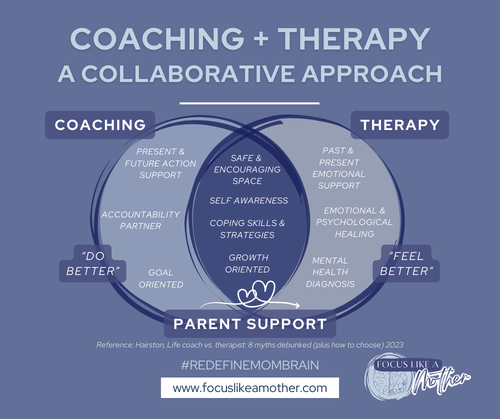
Many people work with both a therapist and a coach. They aren’t redundant—they complement one another and provide comprehensive support, addressing both healing and growth.
Beyond Coaching Vs Therapy
Professional support comes in many forms. Depending on your needs, you might also benefit from:
- Medical care for physical health concerns, diagnosis, and treatment
- Psychiatry for medication management
- Support groups for community connection with others sharing similar experiences
- Specialized services like occupational therapy or neuropsychological evaluation
The key is finding the right fit for your specific situation. Explore our full list of external resources for mental health support, medical care, and community connections.
Choosing Your Path Forward
If you’re experiencing clinical mental health symptoms—depression, anxiety, trauma responses, or patterns that keep blocking your progress no matter how hard you try to work through them—please seek therapy. Your mental health deserves professional clinical support.
If you’re navigating major life changes, feeling stuck, or ready to build strategies for where you want to go (without clinical mental health conditions requiring treatment), coaching provides professional partnership for exactly that.
And if you’re already in therapy but need ongoing support as you navigate daily life and work toward specific goals? You can absolutely do both.
The most important thing is that you get the support you need. Whether that’s therapy, coaching, or both—you deserve help navigating this season.
coaching vs therapy: Related Topics
Learn more about our approach:
- What is Parent Brain Coaching? – How we support parents through cognitive transitions
- How Parent Brain Coaching Works – Our evidence-based methodology
- The Focus Like A Mother Story – Discover how we connect research to real-life strategies
- Meet Your Coach – Learn about our Founder, Megan
Explore the facts:
- Understanding Matrescence – The neurological transition to parenthood (New article coming soon!)
- What Research Says About Mom Brain – Brain changes during parenthood
- Evidence Base – Research foundations for our approach
- A Guide to Experience Coaching – Explore the International Coaching Federation article on coaching
Get support:
- External Resources – Crisis support, mental health services, and community connections
- Individual Coaching Programs – Personalized support options
- Group Coaching – Navigate transitions with community
- Our Resources – Find complimentary worksheets, tips, and more
Ready to Explore If Coaching Is Right For You?
Let’s talk it through.
Book a free 30-minute conversation to explore what’s weighing on you and what type of support might be the best fit. No pressure, just clarity.