
Forgot the daycare nap sheet again? Can’t remember why you walked into the kitchen? Discover what neuroscience reveals about mom brain—and why understanding it changes everything.
TL;DR – Yes, Mom Brain Is Real (And It’s Not What You Think)
Feeling like your brain stopped working after having a baby? You’re not broken. Dozens of neuroscience studies confirm that “mom brain” is real, measurable, and temporary. Your brain is physically restructuring itself to support parenting, which explains the forgetfulness, brain fog, and lost words.
The good news? Understanding what’s happening gives you the tools to work WITH your parent brain rather than fight it. Learn the 5 pillars of brain health that matter most right now, plus take the free Mom Brain Quiz to get personalized strategies for YOUR specific experience.
Wait—Is Mom Brain Actually Real?
Yes. And Here’s What Dozens of Studies Show.

You dropped both kids off at daycare on time this morning—a small miracle in itself. But twenty minutes later, your phone rings. You forgot the baby’s nap time sheet and blanket. Again. You stand there, staring at your phone, wondering how something so simple slipped your mind when you literally just walked out the door.
It’s a bit like wondering where the smart person you used to be went, and when—if ever—she’ll be back. You know she’s in there somewhere, but right now? She feels unreachable.
So, is mom brain real? The short answer: absolutely. Both scientific research and the collective lived experiences of parents worldwide confirm it. Here’s what you need to know.
You’re Not Imagining This—Mom Brain Is Real
I know that feeling all too well. Hearing your phone buzzing, but unable to find it between your purse, the diaper bag, or your coat pocket. Feeling like you can’t think straight, forgetting simple things like words and names, trying to keep thoughts organized, or getting through a to-do list without being distracted or losing track of what you were doing.
“Your brain isn’t broken, incompetent, or failing. It is responding exactly as designed…”
Yes, “mom brain” is real in many ways. You may hear it called baby brain, pregnancy brain, mommy brain, or many other colloquial terms—but whatever name it goes by, what you’re experiencing is measurable and documented.
And you’re not alone in this. There is a whole range of symptoms parents can experience, and everyone’s experience is unique. Some parents notice these changes more than others, but that doesn’t mean you’re doing something wrong or that everyone else has it figured out. For the most part, these changes and adjustments are typical responses to one of the biggest transitions your brain will ever go through.
Your brain isn’t broken, incompetent, or failing. It is responding exactly as designed—even when it doesn’t feel that way.

Your Mom Brain Isn’t Broken—It’s Adapting
Here’s the paradigm shift that changes everything: Mom brain isn’t brain damage or permanent cognitive decline.
Your brain is responding to the enormous demands of parenthood and your changing hormones, quickly adapting and learning to be the best parent for your child. Researchers and authors like Jodi Pawluski, Chelsea Conaboy, and Sarah McKay have documented these changes extensively. They have found that the parent brain undergoes significant remodeling—not deterioration, but adaptation.
Imagine it as if our brain is learning an entirely new operating system (plus more than a few new apps) while still trying to run all your old apps (and save 1,420+ new photos of that adorable baby). The learning curve is steep, and during that transition, some things don’t work the way they used to.
“Since babies don’t come with manuals, our brains go through an intense transformation to quickly learn how to care for and protect our child.”
But here’s what’s important to understand: this is temporary, it serves a purpose, and it’s expected.
What’s Really Happening When You Experience Mom Brain
So what exactly is your brain doing that makes you feel like you can’t think straight?
First, your brain is doing some amazing things! It is responding to the demands of parenthood by changing and adapting. Since babies don’t come with manuals, our brains go through an intense transformation to quickly learn how to care for and protect our child. The catch is that periods of rapid learning, coupled with sleep deprivation and an ever-changing mental load, lead to cognitive struggles.

These cognitive struggles aren’t in your head—they’re actually in your head. Your brain is physically restructuring itself. The memory center of your brain is adapting to prioritize baby-related information, which can temporarily affect everyday memory tasks, like remembering why you walked into a room.
When we talk about “cognitive load,” we’re referring to the total mental effort being used by working memory. Similarly, “executive function” refers to the brain’s ability to manage tasks such as planning, focusing attention, and juggling multiple tasks.
How This Shows Up in Real Life
Your brain is prioritizing differently now. The circuits that help you detect your baby’s needs, respond to threats, and maintain hypervigilance are running at full capacity. This is why you can hear your baby’s cry from three rooms away but completely miss what your partner just said. It’s why you can remember every detail of your baby’s feeding schedule but forget why you walked into the kitchen.
At the same time, your brain is redistributing your working memory and attention. According to researchers Sharon Ettinger and Pamela Geller, what we call ‘mom brain’ reflects a mix of subjective challenges and adaptive cognitive changes that help parents meet new demands.
To better understand how you are using your cognitive resources, you might try reflecting on yesterday’s top three drains on your mental energy. Identifying these can provide immediate insight into where your mental resources are being spent. This quick self-assessment helps you tailor strategies that work best with your current parent brain dynamics.
These mom brain moments don’t signal decline; they signal a much larger evolution. Research suggests these changes persist for at least 2 years postpartum, and some animal and human studies suggest that parenthood may confer long-term protective or adaptive benefits for brain health, though research is still developing.
Your brain is doing exactly what it needs to do to help you parent effectively. The challenge is that our modern lives still expect us to function exactly as we did before, which creates a mismatch between what our brains are optimized for and what we’re being asked to do.
When I Thought My Baby Absorbed My Brain Cells
I remember standing in my kitchen when my son was about 2 months old, completely unable to remember why I’d come in there. The feeling of being lost in my own home, in my own mind, was overwhelming.
That’s when I started thinking things like “my baby somehow absorbed my intelligence when he was in the womb.” Deep down, I knew that wasn’t true, but it sure felt real. My first instinct was to focus on nutrition—more omega-3s and omega-6s, better supplements.
Everything I’d done before to organize my thoughts and my work suddenly didn’t work anymore. The systems that had made me successful felt completely useless. I felt like I was failing at things that used to come naturally to me.
The Moment Everything Shifted
Then a trusted friend reassured me. She’d experienced the same thing decades earlier and told me what I needed to hear. This was a real change, and I’d be okay in the long run. She assured me that I’d figure out new ways to work with my brain. And she was right!
That reframe allowed me to be curious rather than feel defeated. I dove into psychology and neuroscience research papers along with books about “mom brain” and learned that my brain was literally restructuring itself to meet the demands of motherhood. Understanding the ‘why’ gave me permission to stop fighting myself and start working with my brain instead of against it.
Instead of fighting myself and wondering what was wrong with me, I started looking for solutions that worked with my parent brain, not against it. I learned more about why I felt the way I did and explored a whole range of support strategies and scaffolds. I discovered that understanding the science of the parental brain gave me permission to be compassionate with myself and strategic about what I actually needed.
That shift from self-blame to self-understanding changed everything.
So What Do You Do About Mom Brain?
First, take a breath. Understanding what’s happening is genuinely the first step—and you just did that by reading this far.
This won’t be like this forever. I can promise you that. Your brain will truly adapt over time, and research even shows potential long-term protective effects later in life from the neurological changes of parenthood.
The 5 Pillars of Brain Health During This Transition
For now, you have an opportunity to take care of your brain where you can and support it a bit more where you need to. There are five core pillars of brain health that matter even more during this transition:
Sleep (though getting 8 hours isn’t realistic with a newborn, optimizing what you can matters. Try taking power naps when your baby sleeps and banking an extra 15 minutes whenever possible. I know this can feel impossible at times. Just being aware and resting can help your brain.)
Hydration (your brain is 75% water, and dehydration directly affects your brain. A simple start is to sip a glass of water at every feed. Think of it as “if baby is hungry, my brain is probably thirsty.”)

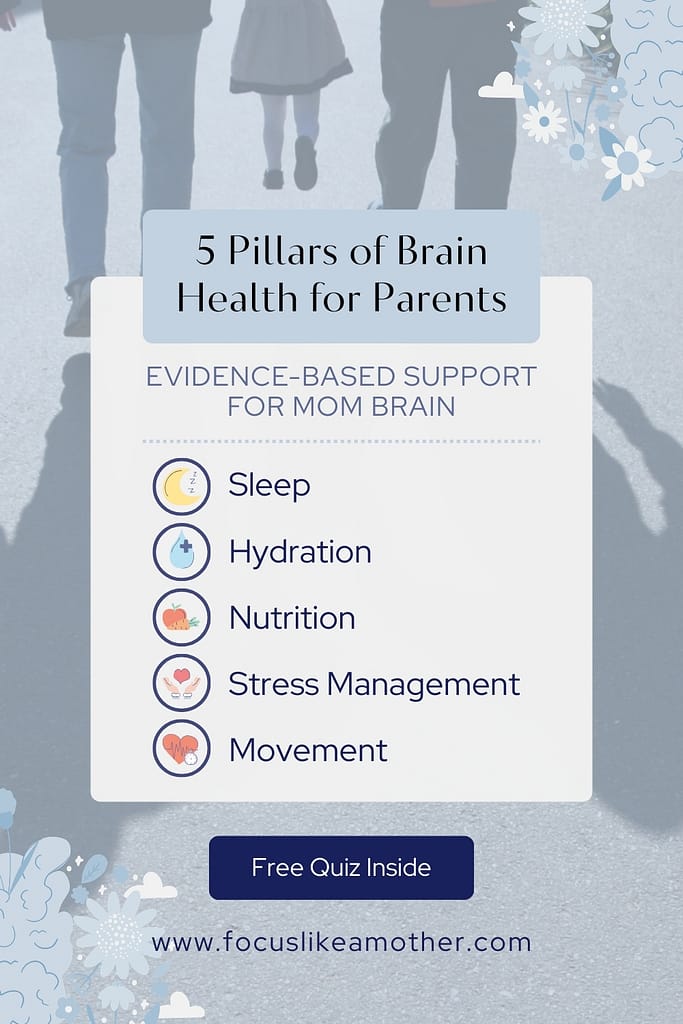
Nutrition (those omega-3s I was focused on? They actually do help brain function. Begin each day with a small serving of walnuts or scrambled eggs to boost your intake.)
Stress management (since chronic stress impairs memory and focus, introduce a 5-minute daily breathing exercise. Even short sessions make a difference.)
Movement (supports cognitive function. Even short walks. Aim for one stroller walk around the block in the morning or as part of an evening routine. Bonus: getting outside and fresh air will also benefit your mental health!)
Working Within What You Can Control
Parenthood adds a level of challenge to meeting your body’s and brain’s needs each day. And let’s be honest, some of these are harder to control than others. There are systemic and social factors at play as well. Not everyone has access to childcare, partner support, or the resources to prioritize these pillars equally. That’s not your fault, and not something you can directly control.
“Being gentle with yourself isn’t just nice, it’s essential.”
Within what you can control, start with just one of the five pillars. Even small improvements in sleep, hydration, or stress management can make a measurable difference. By focusing on an area within your control, you can make tangible progress and prevent feeling overwhelmed by what you cannot change.
Why Self-Compassion Is Your Secret Weapon
Working with your parent brain is different than trying to get your ‘old brain’ back. You need different approaches, different systems, and a lot more self-compassion.
Here’s why self-compassion matters: research shows it actually improves cognitive flexibility. When you’re kind to yourself about forgetting the nap sheet, your brain has more capacity to adapt and problem-solve. When you’re beating yourself up? That adds to your cognitive load, making everything harder.
Being gentle with yourself isn’t just nice, it’s essential.
Either way, you’ll learn skills that will serve you well in this season of parenthood and beyond.
Your Next Step: Discover Your Mom Brain Type
Mom brain shows up differently for everyone. Some parents struggle most with memory, others with focus or decision-making. Some notice brain fog, others experience overwhelm or difficulty with word-finding.
I’d love to hear from you: Which mom brain moment made you question your sanity this week? Was it forgetting why you walked into a room, losing your train of thought mid-sentence, or something else entirely? Drop a comment below or tag me on social media—I promise you’re not alone in this!
Take the Parent Brain Type Quiz to understand your specific experience and get personalized strategies that actually align with how your brain functions. It takes about 5 minutes and gives you a customized roadmap for working with your parent brain, not against it.
And if this helped you understand what’s really happening in your parent brain, don’t keep it to yourself! Share it with a friend who needs to hear that they’re not broken—just adapting.
Want to dive deeper into the research? Find detailed sources and studies on our research page.
